

Published on 24/10/24 & Updated on 14/10/25
Metadata is an integral part of SEO which tells search engines important information about your page, allowing them to understand it and display it to users.
It is found in snippets of the HTML code on your website which provide information about your content.
In relation to SEO, two key types of metadata are meta titles and meta descriptions.
Optimising these elements will aid in improving your website’s visibility, driving in more organic traffic and enhancing user engagement.
Let’s dive into what these aspects of metadata are and how you can use them to level up your SEO strategy…
What Is a Meta Title?
A meta title simply refers to the title you choose to give to a page on your website. It is displayed both on search results and the page’s tab in browsers, signifying the topic of the page.
Why Is a Meta Title Important?
- Affects Rankings: The page’s meta title is one of the first elements search engines will use to understand its content and decide its ranking. Incorporating your main keyword into your page’s title can greatly improve its ranking.
- Improves CTR: The title is a key opportunity to grasp the attention of users as it is the first thing they see on search. A relevant and engaging title can improve your website’s click-through rate (CTR).
- Increases Brand Awareness: A title is a great place to include your brand’s name which will help build brand awareness and authority.
What Is a Meta Description?
A meta description is a brief summary of a webpage’s content that typically appears underneath the page title and URL in search engine results.
Meta descriptions don’t directly influence ranking, but they can significantly impact click-through rates (CTR), which affect how useful and relevant search engines believe your content is. Quality and relevance are two of Google’s key ranking factors illustrating the indirect link between meta descriptions and ranking.
Why is a Meta Description Important?
- Increases CTR: When users can easily understand your meta description, it encourages them to click on your page, improving your click-through rate (CTR). CTR is used by search engines when determining how relevant your page is to the user’s query.
- Informs Google: Meta descriptions tell Google what your webpage is about, making it easier to rank your page to answer search queries.
- Improves User Experience: Meta descriptions are the key area which help users understand what your page is about before they choose it. If your description is accurate, users will receive the information they sought, reducing bounce rates and increasing time spent on the site.
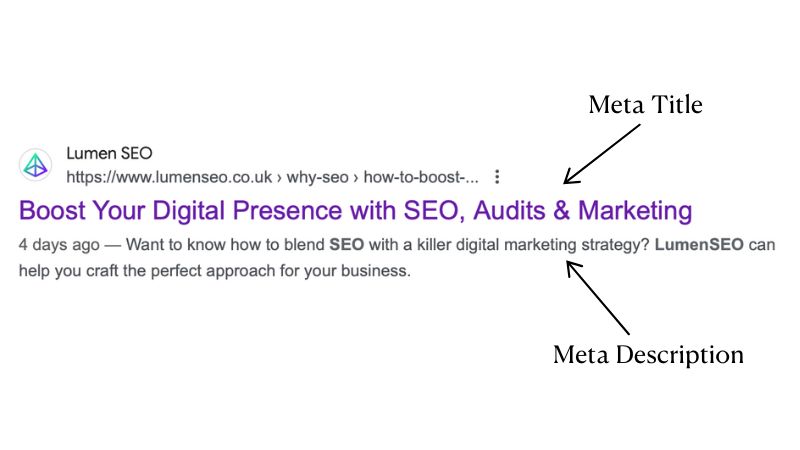
Here is an example of what a meta title and meta description look like:
6 Metadata Best Practices
Let’s move on to our top 6 best practices for optimising metadata:
1. Align Metadata With User Intent
When creating both your meta titles and meta descriptions, you need to understand your target audience’s search intent first. This means understanding what your potential clients are looking for and the words they’re using to search for it.
Make sure that, after you have done your keyword research, you place your primary keyword in your title and early on in your meta description. This will help search engines notice that your page is relevant to the search query, boosting its ranking.
Additionally, since you have a chance to briefly explain the page’s content in the meta description, it’s important to get the phrasing just right! There are multiple types of intent that a user may have when searching online. For purposes of meta descriptions, the two we’ll focus on are:
Informational Intent
Informational intent happens when a searcher wants to learn more about a topic, such as keyword research. Keywords with informational intent are often phrased as questions, for example, ‘how to do keyword research‘. In this case, your meta description can tease the answer so the searcher will hopefully click into your website to learn more.
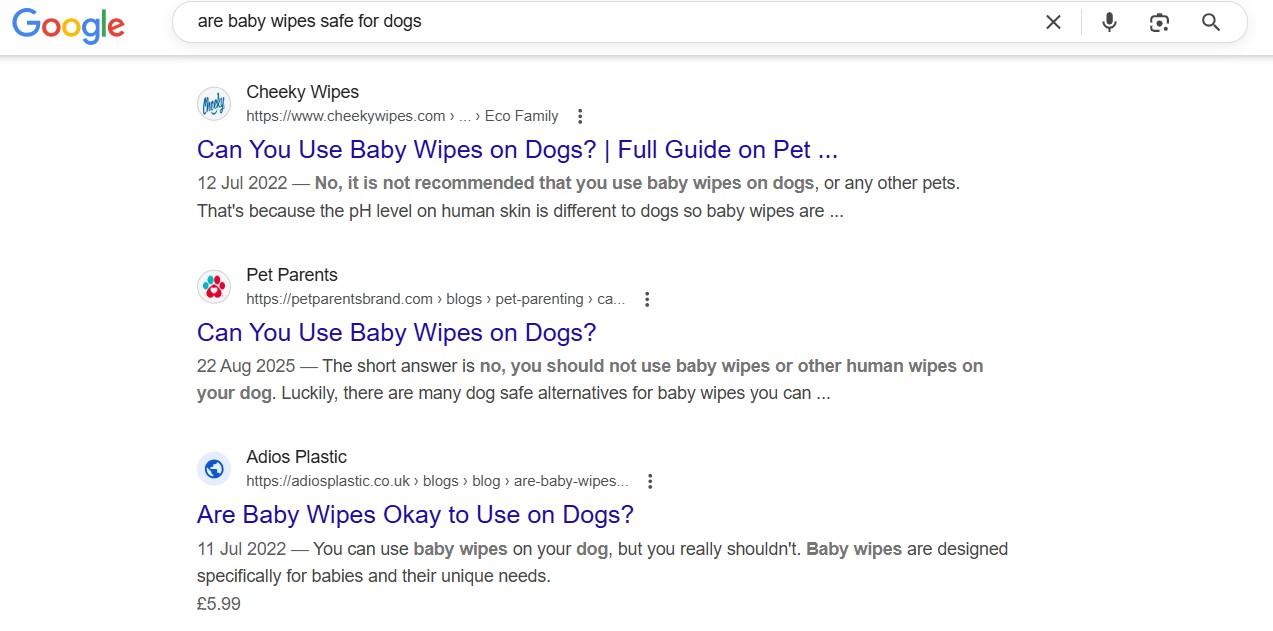
Here’s another example of informational intent. On this Google results page, our client Cheeky Wipes is ranking for the keyword ‘are baby wipes safe for dogs’. You can see how the meta descriptions chosen by Google (and increasingly Google is rewriting metadescriptions with AI) answer the question directly:
Transactional intent
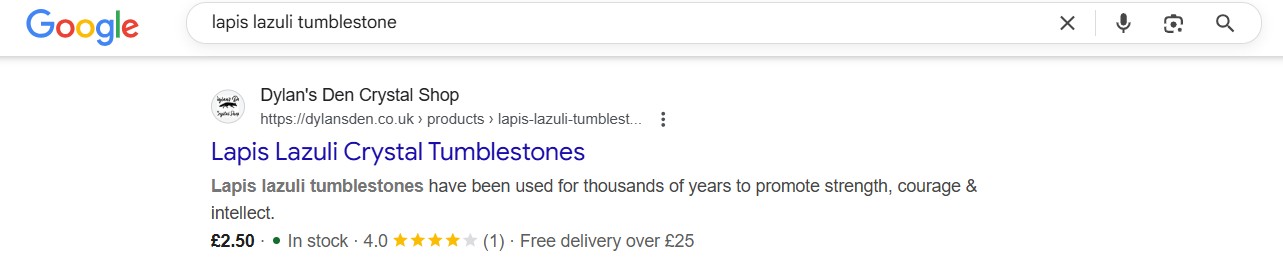
On the other hand, a searcher’s intent is transactional if they want to purchase an item or service, such as a ‘lapis lazuli tumblestone’. In this case, a meta description is your opportunity to sell your product.
For example, our client Dylan’s Den‘s meta description tells us more about their gemstones, ‘Lapis lazuli tumblestones have been used for thousands of years to promote strength, courage & intellect.’
2. Write Succinctly, Focusing on Users
An incredibly important aspect of SEO to focus on is user experience. It can be tempting to craft your strategy only thinking about what search engines will like and rank highly. This can do more harm than good as user experience and high rankings are intertwined. Google uses user experience as a key factor when deciding where to rank your webpage.
To focus on user experience, your metadata should be relevant and answer the user’s query succinctly.
Take great care when writing your title and description as if they are too long, they will get cut off on search results. Meta titles should be between 50-60 characters long. Meta descriptions should be between 150-160 characters to ensure they’re fully displayed.
We recommend using Spotibo’s Meta Description Length Checker and always previewing your content to ensure the full title and description can be seen.
3. Utilise a Call to Action
Incorporating a call to action in your meta description can increase the likelihood of users clicking on your link. Phrases such as “learn more,” “discover,” “order”, or “check out our…” encourage users to take immediate action, improving your CTR.
If you’d like help with your metadata or overall SEO strategy, contact our SEO consultants today!
4. Avoid Overuse of Special Characters
It is key to make your meta titles and descriptions stand out and entice readers. An easy way to do this is by including special characters, such as exclamation points, vertical bars or dashes, but it’s important to be cautious.
This is because overusing them can make your content seem like spam.
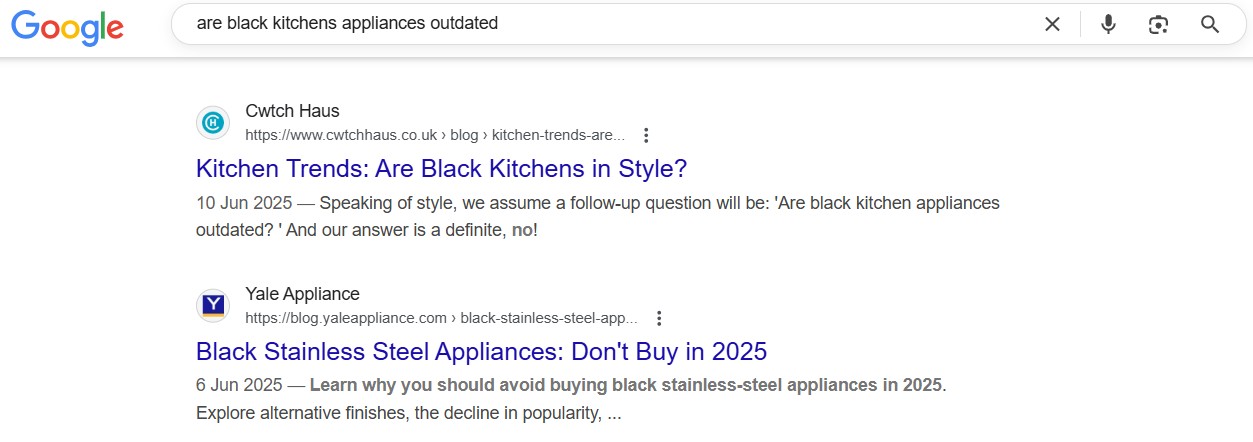
We recommend using one or two special characters in your meta title and descriptions. For example, you can use a question mark and a vertical bar in your title, and an exclamation mark in your description.
5. Refrain from Duplicating Metadata
Each page on your website should have its own unique meta title and description.Duplicate metadata can confuse search engines and your users about your page’s contents, decreasing user experience and reducing CTR.
Use tools like Yoast SEO or Screaming Frog to identify duplicate meta descriptions and titles on your site.
6. Branding Opportunity
Your meta title and description are great opportunities to build brand awareness. This refers to how well your brand is recognised.
The recognition of your brand name specifically can be increased by incorporating it into your metadata.
For meta titles, we recommend writing your title, then adding a vertical bar followed by your brand name. For example, “What Is Metadata in SEO? | Lumen SEO”. It is important to only do this if adding your brand name will keep your meta title within the optimal amount of characters. It is not worth adding your brand name if it will be cut off on search.
If you’ve added your brand name in your meta title, it is unnecessary to include it within your meta description. However, if you weren’t able to add it to your title, then a great place to incorporate it can be the meta description. Remember to only include your brand name here if it is coherent and useful to the reader.
Will Google Rewrite My Metadata?
If you’ve written metadata you’re proud of, you search it and something else comes up, you’re not alone! Google will sometimes replace your metadata with content pulled from your page and, in a new development, the search engine is trialling replacing metadata with AI-generated descriptions.
Does this mean it’s not worth updating your metadata? Not at all. Optimising your metadata is still one of the most powerful ways to increase click-throughs to your website. Offering the best metadata you can gives you the best chance of converting impressions into traffic.
You can think of not optimising, well, like setting up a shop window and not bothering to paint the sign. No matter how search changes going forward, optimising your metadata is still a quick win.
How Lumen SEO Can Help
We at Lumen SEO can take care of your whole SEO strategy, including keyword research, link building, content writing and technical SEO. You can learn more about what an SEO agency, like ours does, here.
If you like the sound of working with us, we offer free, no-obligation SEO audits on business websites. To claim yours, simply enter your details here and we’ll get a free SEO audit to you within 7 days. It will include the strengths and weaknesses of your website along with the top three aspects you should focus on improving, in order to enhance your business’ ranking.
For a friendly chat about the SEO services we provide here at Lumen SEO, contact our SEO consultants today. Alternatively, you can message us on either our LinkedIn or Instagram pages.
Written by Viktoria, for Lumen SEO.


