18/11/2024
Whether you’re new to blogging or have written for years, knowing how to write a blog that ranks can feel like a minefield.
Anyone well-versed in Search Engine Optimisation (SEO) understands that there’s a distinct difference between writing blog posts and writing SEO-friendly blog posts.
As of 2024, there are 600 million blogs on the internet, making the fact that Ahrefs has found that 96.55% of content gets no traffic from Google all the more shocking.
If you’re curious to learn how to write SEO-friendly blog posts, our guide is here to help.
To write SEO-friendly blog posts, you will need to:
1. Select The Right Keywords
Before you begin writing your SEO-friendly blog, you’ll first need to carry out keyword research.
While you might have a topic you’d like to cover in mind, demand and search intent is important to bear in mind.
If no one is searching for the topic, you naturally won’t get any search traffic. Additionally, if the demand is too high, you might not be able to compete.
When writing your blog, you will need to incorporate the keywords you have selected throughout.
However, take care to ensure that when you incorporate a keyword it flows naturally into the sentence, as Google does not favour sites that resort to ‘keyword stuffing’.
2. Optimise Your Blog For A Featured Snippet
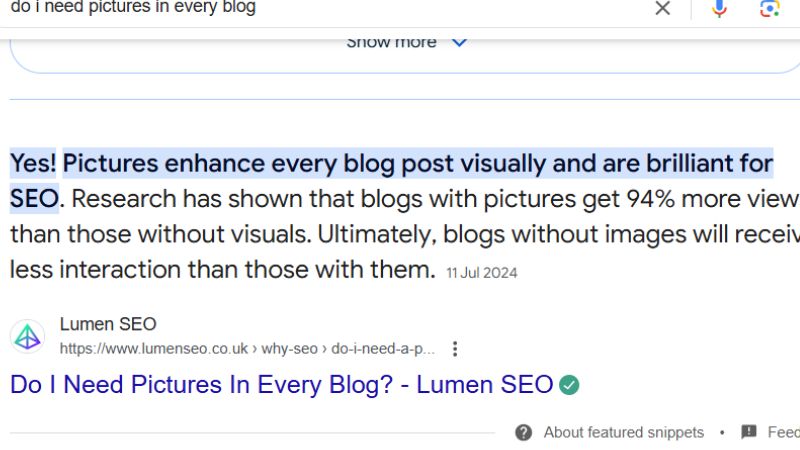
A featured snippet on Google is a highlighted piece of text that appears at the top of Google search results.
Their purpose is to provide users with an answer to their query as quickly as possible, and if you can earn one and a position “0” on Google, this can help draw traffic to your website.
Currently, there are four types of featured snippets on Google, which include paragraphs, lists, tables, and videos.
How To Optimise For Featured Snippets
There are a few ways you can optimise your blog for a featured snippet, but today we’ll cover paragraph snippets and list snippets. You can earn a featured snippet by:
- Answering the question straight away (Paragraph snippet) – Google rewards sites that can provide an answer to the reader quickly in a paragraph. If your blog is structured to answer a specific search query in the first couple of paragraphs, it has a higher chance of being crawled for a featured snippet.
- Writing a list of at least five points (List snippet) – Another way in which you can achieve a featured snippet is to write a blog that contains a list of at least five points. This list can be numbered or in bullet points, and can be ordered or unordered. The longer the list, the more comprehensive and detailed a blog generally is.
Earning a featured snippet, then, serves as a nod from Google and signals to users that your content is both trustworthy and authoritative.
3. Focus On Demonstrating E-E-A-T
For your blog to be SEO-friendly, you’ll also need to focus on demonstrating E-E-A-T.
E-E-A-T stands for Experience, Expertise, Authoritativeness and Trustworthiness, which are part of the criteria Google’s search quality evaluators use to evaluate search results.
Google defines high quality pages as pages that have a high level of E-E-A-T, so naturally, E-E-A-T impacts your SEO.
How To Demonstrate E-E-A-T In Blogs
Experience
You can showcase your experience by sharing that there are real people behind your business.
Demonstrate that there’s a legitimate organisation behind your website by including an About Us or Team page that includes your team’s credentials.
When creating your content, highlight the expertise in your organisation as well as the services and content you’re producing.
Expertise
Expertise relates to the knowledge demonstrated within your blog. It’s important to indicate to your reader why you’re qualified to talk about this topic.
When someone produces a blog on your website, consider adding the author’s name as well as a bio containing any relevant qualifications to demonstrate expertise.
Internally linking also helps to direct users to other topics you’ve covered whilst improving navigation and user experience, helping you to demonstrate further expertise in your industry.
That said, there are best practices for internal linking that you will need to be aware of for the best results.
Authoritativeness
Adding external links that add value to your content is crucial to demonstrate that you’ve done your research.
When making claims in your blog, back this information up with external links that come from trusted sources to demonstrate authoritativeness.
Over time as you gain quality backlinks yourself from trusted sources, this will also indicate to Google that you’re an authority within your niche.
Trustworthiness
Demonstrating trustworthiness in your blog could include links to your testimonials or reviews page.
This will indicate to your readers that you are a trusted source of information and that people have good experiences with your brand.
Note: The length of your blog is also important to demonstrate E-E-A-T. Generally speaking, your blog should be long enough that you comprehensively cover the topic, but not so long you dilute the value of the article.
To learn more about E-E-A-T in SEO, be sure to check out this blog.

4. Include Images, Captions & Alt Text
To write an SEO-friendly blog post, you’ll also need to include images, captions and alt text.
Generally speaking, you will need to include at least three high quality images in your blog. The importance of this is highlighted by the fact that ‘articles with images get 94% more views than those without’.
Images help to break up the text and provide visual appeal whilst captions can add further value to your content.
Providing alt text is also crucial, as this helps screen reading tools to describe images to visually impaired readers and helps Google to better crawl and rank your site. As such, this should never be underestimated.
5. Include A Varied Heading Structure
When writing an SEO-friendly blog post, you will also need to include a varied heading structure.
Why Are Headings & Subheadings Important For SEO?
Headings and subheadings break up your content, making it easier to digest and provide logical structure to a page. Including a varied heading structure helps search engines to crawl your content, which is important for SEO.
Moreover, headings and subheadings make it easier for users to read and understand your content as they signpost what your content is about, improving the user experience of the page and therefore how useful your site is.
Generally speaking, headings should be ranked in order of importance from H1 to H6, with H1s typically only being used for the title to ensure good SEO.

6. Optimise The Metadata
The metadata includes your meta title and meta description, which are short descriptions that both act as signposts to tell search engines and readers precisely what a web page is about.
Optimising your metadata with your keywords, as well as ensuring it’s the correct length are the keys to boosting your content’s SEO.
Good news is that there are a range of free tools that you can use to ensure your metadata is the correct length, including Spotibo.
Failing to optimise your metadata is not only a missed opportunity but will also make it more difficult for Google to crawl your blog content.
How Lumen SEO Can Help
We at Lumen SEO have years of experience in writing blog posts that rank.
If you need help writing SEO-friendly blog posts, or wish to learn more about the SEO services we provide at Lumen SEO, such as SEO coaching, contact us today.
Alternatively, you can message us on either our LinkedIn or Instagram pages.
Written by Jemima for Lumen SEO.