External links are hyperlinks that direct your readers to other websites. While they may seem counterintuitive to include in your content, they can be incredibly useful to help you rank higher on search engines and build a level of credibility for your brand.
In order to create an external linking strategy, it is vital to follow the best practices to maximise your website’s benefit.
What are the Benefits of External Links?
Before we delve into external linking best practices, below are a few key reasons why external links are beneficial:
Building Credibility
Including links to reputable, high-quality sources increases the trustworthiness of your writing. It demonstrates that you have done your research and are giving people useful, reliable information.
Boosting SEO
Google views external links as a signal of quality content, as high-quality pages usually link to other high-quality pages. This helps boost E-E-A-T (expertise, experience, authority and trustworthiness,) which means search engines will look at your content favourably, helping you rank higher.
Adding Value
Links that lead to related information add value to your content and enhance user experience. This is because users can easily discover further information to deepen their understanding of the topic at hand. The ease and quality that this brings to the user will enable them to psychologically associate more value with your website.
Generating Backlinks
When you link to other sites, there’s a chance that they might reciprocate by linking back to you. This generates valuable backlinks to your site, which are crucial for improving your domain authority and SEO.
Creating Connections
As well as enabling connections within the web ecosystem, external links can also be useful for creating connections with other professionals. Other websites notice when you link to them, providing a positive avenue for building connections with other experts in the industry.
The 8 Best Practices for External Linking
Here are our favourite external linking best practices:
1. Link to Authoritative and Relevant Sources
Overall, the main goal of adding external links is to direct your readers to other high-quality information that will enhance their understanding of your content. Therefore, it is crucial to link to authoritative and relevant sources.
Google evaluates the quality and relevance of the websites you link to and uses the result to determine your content’s credibility and ranking. The better the websites that you link to are, the better your own website will appear.
Make sure to conduct thorough research on the sources you can link to and choose educational institutions or well-known industry leaders, as they are generally considered authoritative. Always check the sources you’d like to link to and ensure they are directly relevant to the topic you have written about.
2. Use Descriptive Anchor Text
External linking best practices dictate that when adding an external link, the visible, clickable text in the hyperlink is named the anchor text. There are 2 types of anchor text – either descriptive or non-descriptive. An example of descriptive anchor text is a detailed description of where the link will take you, such as “external linking guide”. On the other hand, an example of non-descriptive anchor text is vague phrases like “click here”.
Here is a brilliant, illustrative example from Moz on what descriptive anchor text looks like:
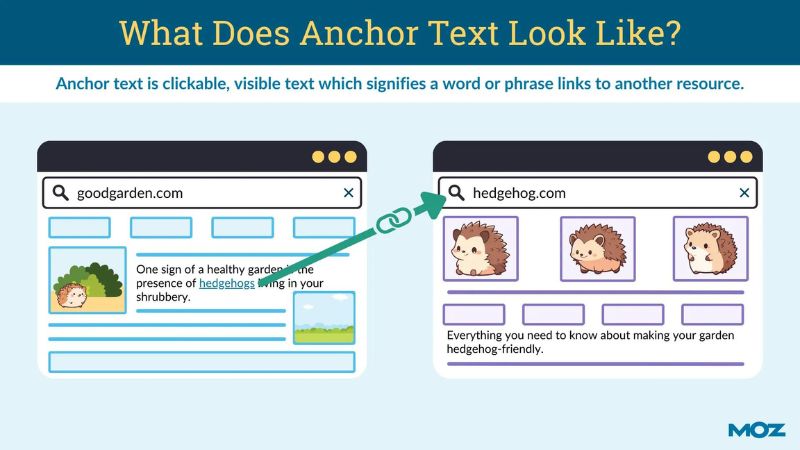
It is important to use descriptive anchor text as this helps to provide the context for the link, making it clear both for Google and the reader. This can contribute to improved rankings as Google will understand your links better, and your website’s user experience will be enhanced since its navigation will be more informative.
Overall, steer clear of generic anchor text like “read more” or “click here.” Instead, make use of precise language to convey what you are linking to.
3. Balance the Number of Links
External linking is great, but it’s best practice not to overdo it. Including too many external links can overwhelm your readers and distract them from the main message of your content.
Remember that it is also vital to add internal links to your content as they help search engines to understand the structure and hierarchy of your website. Therefore, a good balance between internal and external links is key, along with not going overboard with the two!
We recommend 1-2 links per paragraph and balancing the amount of internal versus external links as the best practice.
4. Conduct a Link Audit
The easiest way to determine how well your site is performing regarding its links is to conduct a link audit. This is essentially a thorough analysis of your links, presenting you with which links are outdated and which are broken, too! Conducting an audit is a massive time saver, especially if you’ve published a lot of content.
If you’d like a free audit from us, we can assist you with links, and luckily for you, our free audits are comprehensive! This means that we will analyse your whole SEO strategy. Fill in our free audit form or contact us if you’d like one!
5. Regularly Update Links
In SEO, the conversation around updating content is constant. In particular, external links can become broken or outdated. This can negatively impact user experience and SEO, which, as we know, go hand in hand.
This is because users will become frustrated, and Google takes broken links as a signal of poor site maintenance. There’s nothing more annoying than seeing an Error 404 every 2 seconds!

For external linking best practices, ensure that you regularly monitor and update your links, checking that they work and that they are still valuable to the piece of content. If at any point you cannot find a suitable replacement, it is absolutely okay to remove the link altogether.
6. Ensure External Links Open in New Tabs
It’s recommended that external links open in new tabs as this makes it easier for users to comprehend the links’ content without losing your article.
By providing an easy way for your users to return to your original site, you can increase user satisfaction and, subsequently, your search rankings.
7. Link to Diverse Sources
As we’ve mentioned, the main aim of external links is to aid your readers in increasing their understanding and knowledge of the topic you’re discussing. To do this, it’s beneficial to diversify the types of sources you link to.
You can link to news sources, other industry blogs, academic journals or educational institutions. This will not only benefit your reader, but it will also display to Google that you’ve thoroughly researched other perspectives, enhancing your website’s trustworthiness and overall SEO.
8. Avoid Linking to Competitors
In order to drive traffic to your website, it’s best to avoid linking to your direct competitors. However, this is a nuanced subject as the term ‘competitors’ is sometimes used too broadly.

For instance, if you are a marketing agency, it is advisable not to add links to other marketing agencies’ websites as these are your direct competitors. However, it is not a problem to link to educational marketing services that your company is not competing with.
How Lumen SEO Can Help
We at Lumen SEO can take care of your whole SEO strategy, including keyword research, link building, content writing and technical SEO. You can learn more about what an SEO agency, like ours does here.
If you like the sound of working with us, we offer free, no-obligation SEO audits on business websites. To claim yours, simply enter your details here and we’ll get a free SEO audit to you within 7 days. It will include the strengths and weaknesses of your website, along with the top three aspects you should focus on improving, in order to enhance your business’ ranking.
For a friendly chat about the SEO services we provide here at Lumen SEO, including SEO coaching, contact our SEO consultants today. Alternatively, you can message us on either our LinkedIn or Instagram pages.
Written by Viktoria, for Lumen SEO.