Off-page SEO refers to optimisations that happen off-site to improve a website’s ranking in search results.
Developing your SEO strategy is absolutely critical to boosting your website’s visibility and organic traffic. SEO can be divided into two main categories: on-page SEO and off-page SEO. Understanding the differences between these two types and how they work together is essential for any effective SEO strategy, so let’s dive in.
What Is On-Page Vs Off-Page SEO?
Before exploring off-page SEO in more detail, it’s vital to understand the distinction between on-page and off-page SEO.
Here is a great summary of the difference between on-page and off-page SEO by Semrush:
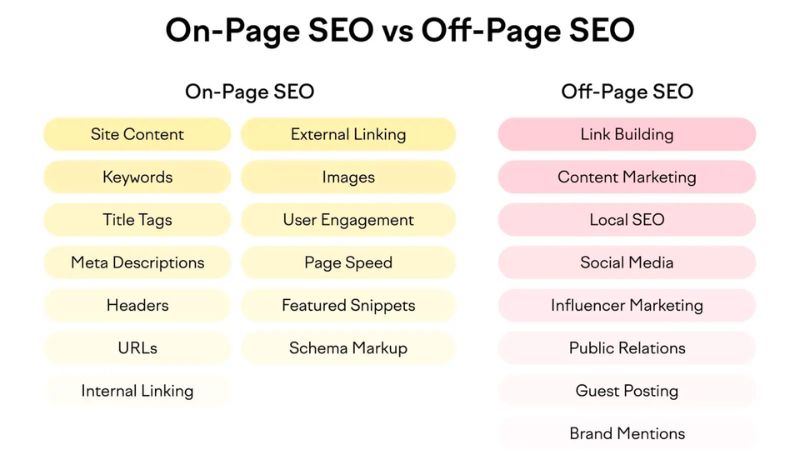
On-page SEO encompasses all the optimisations you make directly on your website to improve its search rankings. This includes elements such as:
- Keywords: Incorporating relevant keywords into your content.
- Internal Linking: Including links to other related pages on your website to improve navigation and help boost other pages.
- External Linking: Adding links that direct visitors to other websites that can provide them with more useful and reliable information to enhance their understanding.
- Meta Tags: Writing compelling meta titles and descriptions to grasp your readers’ attention.
- Page Speed: Ensuring your site loads quickly to retain user satisfaction and reduce bounce rate.
In comparison, off-page SEO is all about the actions you take off-site to help improve your search rankings and build your site’s authority. It is just as important as on-page SEO for achieving high rankings. Off-page SEO includes elements such as:
- Link Building: An SEO tactic that aims to result in other websites linking to your website.
- Local SEO: The practice of making adjustments to your website so that it appears higher up in local search results.
- Social Media: Engagements on social media posts such as likes, comments and shares can indirectly boost your website’s authority.
- Guest Posting: Publishing free articles on other websites in your niche to build backlinks and generate traffic to your website.
- Brand Mentions: References to your brand across multiple different websites contribute to your site’s reputation, even without a hyperlink.
Why Is Off-Page SEO Important?
Off-page SEO is very important and helpful to your business as it will improve your search rankings. The higher your website is ranked, the more organic traffic you will receive.
Furthermore, strategies like social media marketing and guest posting can significantly further increase your visibility to potential customers, providing you with a competitive edge.
Receiving links from authoritative sites helps build trust with both search engines and users, establishing your site as a reliable source of information.
All of these factors are greatly important to Google and make up part of its decision process on where to rank your website. Google outlines this process as E-E-A-T which looks at whether your website has expertise, experience, authority and trustworthiness.
How to Improve Off-Page SEO
Below are our top 5 ways to improve your off-page SEO:
1. Build Backlinks
As mentioned above, link building is the process of getting other websites to link to your site. The hyperlinks themselves, that link from other websites to yours, are named backlinks.
When a website has a large number of backlinks, it signals to Google that they are an authoritative site since so many other sites are referencing them. It is especially helpful if the backlinks come from reputable domains.
This is crucial as Semrush’s 2024 Ranking Factors study shows that domain Authority Score is the sixth strongest predictor of a webpage’s ranking position.
Here are our tips on building backlinks:
- Quality Content: Ensure that you are creating content of the utmost quality. Check that it is accurate and relevant to your intended audience, as well as being written in a compelling way. High-quality, informative content has a greater chance of being discovered and linked to by others.
- Identify Broken Backlinks: You can use tools such as Semrush’s Broken Backlink Checker to find any backlinks you’ve received that have become broken. Afterwards, you can contact the publication and ask them to fix the link.
- Journalist Requests: Journalists often require comments from businesses to add to their articles. Once you help them out, they are likely to link to your site within their article. You can look for journalist requests on platforms such as Connectively and Qwoted. Also, you can reach out to journalists and bloggers explaining that you could be a source for their writing.
- Guest Posting: Find a reputable website in your industry and offer to write a guest post. By doing this, you receive a reputable backlink and the website you’ve chosen receives a free article.
Make sure that you regularly check your backlinks using tools such as Ahrefs, Moz or Neil Patel.
2. Leverage Social Media
Social media has more of an indirect impact on your website but it is still a key part of off-page SEO. The exposure and engagement your brand can receive will boost its visibility, indirectly impacting rankings. You can also include direct links to your website within posts or stories to gain more traffic.
To best utilise social media, post regularly on all of your platforms. We recommend posting around 3 times a week.

Once you’ve published your content, your social media efforts shouldn’t stop there. Ensure that you continuously engage with your audience by liking and responding to comments, as well as interacting with their feeds. Building relationships with your audience fosters brand loyalty.
If you’d like to widen your reach, you could collaborate with other industry professionals and create content together. You could also consider beginning a podcast where you discuss your content and business in general. This can be highly beneficial as it can reach different audiences and help your brand, and subsequently your website, to be more well-known.
3. Focus on Local SEO
If you are a local business, you have a highly effective opportunity to increase your organic traffic simply by focusing on local SEO. Research shows that 46% of Google searches have local intent meaning that people use language like city names or the phrase “near me”.
To optimise for local SEO, a Google Business Profile is key. Make sure that you create a profile for your business and keep your name, address and phone number up-to-date and consistent. These elements make it easy for search engines to find and rank your business. Add these details to the header or footer of your website, along with the ‘contact us’ page too.
When creating content, conduct thorough keyword research on what language is being used to search about your industry in your area. For example, if you are an interior design company in Cardiff, discover what your audience is searching for. They will likely be searching “interior designer Cardiff” which gives you a goal of which keywords to rank for.
If you’d like help with your local SEO and your overall strategy, we are currently offering free audits! To sign up, fill in the free audit form or contact us.
4. Publish Testimonials and Reviews
Psychologically, humans seek social validation, trustworthiness and relatability. This explains why 92% of people trust word-of-mouth recommendations over advertisements. Your SEO strategy should always aim to bring organic traffic to your website and a great way to do so is by having a bank of reviews and testimonials for your visitors to see.
The distinction between the two is that testimonials are more formal, focusing on the specific results that a customer has achieved by working with you. Contrastingly, reviews tend to be more informal and provide a general overview of the customer’s experience.

What is your company really like? How do your team support customers? Is your product or service worth it? These are all questions that intrigue potential clients and can all be answered through testimonials and reviews.
Reviews are often seen on your Google Business Profile providing yet another reason why it is crucial for your business to have one. It is also beneficial to post testimonials and reviews on social media to reach a wider audience.
5. Lead & Attend Events
People frequently forget the importance of cultivating a brand outside of online marketing but this can be an advantageous aspect of your off-page SEO.
Leading events draws attention to your brand and allows potential customers to experience working with your team. This can be an invaluable way to showcase your expertise and brand culture.
If you’d like to come to one of our events, you’re in luck as we are holding an SEO Masterclass on September 17th. We’d love for you to come along!
As well as leading events, attending them can be equally beneficial as it provides you with a chance to network with other industry professionals and even gain backlinks.
How Lumen SEO Can Help
We at Lumen SEO can take care of your whole SEO strategy, including keyword research, link building, content writing and technical SEO. You can learn more about what an SEO agency, like ours does, here.
If you like the sound of working with us, we offer free, no-obligation SEO audits on business websites. To claim yours, simply enter your details here and we’ll get a free SEO audit to you within 7 days. It will include the strengths and weaknesses of your website along with the top three aspects you should focus on improving, in order to enhance your business’ ranking.
For a friendly chat about the SEO services we provide here at Lumen SEO, contact our SEO consultants today. Alternatively, you can message us on either our LinkedIn or Instagram pages.
Written by Viktoria, for Lumen SEO.