

The speed of your website can significantly impact the quality of your website, user experience and search engine rankings. We all know the frustration of a slow-loading page which often leads to leaving a website. Fast website speed is a fundamental element of technical SEO which focuses on enhancing the technical aspects of a website with the result of improved visibility, mobile-friendly sites and overarchingly increased user satisfaction.
Why Is Website Speed Important?
Prioritising speed is essential to ensuring the best possible performance from your website, as faster-loading websites appear more reliable and rank higher in organic search results. Increased visibility of the website results in increased conversion rates and overall business success.
Here is a summary of why website speed is so important by Webcertain:
Below are several reasons why you should prioritise website speed :
- User Experience: Users typically expect web pages to load quickly. Studies reveal that if a site takes longer than 3 seconds to load, 40% of visitors will abandon it. Now more than ever, users’ attention spans are decreasing. Hence, it is vital to adhere to the website speed guidelines of between 1 and 2 seconds to retain their attention. Faster websites provide greater opportunities for engagement and increase customer satisfaction.
- SEO Rankings: Google states that loading speed is a direct ranking factor for search engine results. Faster-loading websites are prioritised within their ranking algorithm compared to slower-loading websites. This means a faster website presents your business with a competitive advantage compared to those with slower pages.
- Bounce Rate and Dwell Time: Website speed affects behaviour metrics such as bounce rate and dwell time, which tell search engines about the relevancy and quality of your website. Bounce rate refers to the percentage of people who open your page and leave whereas dwell time refers to the duration a visitor spends on a webpage before returning to the search engine results page. Websites with slower loading times have a higher bounce rate because users are more likely to depart before the page loads completely. This indicates to Google that users aren’t finding the content useful or relevant, leading to lower rankings. Conversely, a fast-loading website encourages users to stay longer and engage with your content, which can improve your dwell time, signifying that your content is of the utmost quality.
- Mobile-First Indexing: In 2016, Google switched to mobile-first indexing by default for all new websites. This has meant that mobile web pages must be as complete as a desktop version in order to boost SEO rankings. Generally, mobile users experience more page-loading issues than desktop users. Therefore, it is vital to ensure your site is fast on mobile devices.
- Crawl Efficiency: Crawl efficiency refers to how effectively search engine bots, known as crawlers, can navigate and index the pages of your website. Achieving higher visibility in search engine results pages depends on search engines being able to rapidly and accurately analyse your site’s structure, content, and updates, which is crucial for achieving better visibility in search engine results pages. This links to website speed as a fast-loading website enhances crawl efficiency, allowing bots to index more pages within their crawl budget. Comparatively, if your website is slow, search engine bots might not be able to crawl all your pages, which can negatively affect your site’s indexing and ranking.
6 Easy Ways To Make Your Website Load Faster
1. Optimise Your Images
Images tend to be the largest file within a site page leading them to often take the longest to load. In fact, all images that appear on a webpage need to be downloaded by the user’s browser before they can be displayed. This particularly affects mobile users as large images will also use up a lot of their data as they download. Thankfully, this loading time can be significantly reduced through optimisation.
Reducing the size of images to ensure no image is above 100KB will greatly reduce loading time. Taking image format into consideration is helpful to achieve this as, for instance, JPEG files take up less space compared to PNG. This is because JPEGs are designed to efficiently store high-quality detailed photos while compressing large images into much smaller file sizes, making them easier to share and upload. If changing the image format does not compress your images to under 100KB, you can also use an image compressor such as Image Resizer. Ensure that your images still look professional on large and small devices as compressing images can sometimes result in very low resolution.
2. Enable Browser Caching
The browser cache is a temporary storage location where browsers save copies of static files so that they can load recently visited web pages more quickly. Developers can direct browsers to cache sections of a web page that are static to avoid requiring the device to receive the entire page every time. This greatly reduces the amount of data that the server needs to transfer to the browser, shortening load times for users who frequently visit certain pages.
To learn more about this topic, read this helpful guide on browser caching.
3. Repair Broken Links
Repairing broken links is crucial for maintaining and enhancing your website’s page speed as a large number of broken links can cumulatively slow down your site.
When users encounter broken links, they experience a disrupted browsing experience which can lead to increased bounce rates and decreased user satisfaction. Additionally, broken links prevent users from accessing the content they are looking for, which reduces engagement and can negatively impact conversions.
Furthermore, Google considers the number and quality of internal and external links when ranking pages. Broken links can signal poor site maintenance and reduce your site’s authority, negatively impacting SEO rankings. Search engine bots may also waste their crawl budget on broken links, which could have been used to discover and index new or updated content on your site to enhance your website’s ranking.

An effective way to identify and repair broken links is to conduct regular audits of your website. Tools such as Semrush and Screaming Frog can help find and fix any broken links that are causing problems. However, if you feel you need more support with this and would like professional help, contact us for a free audit. To learn all about the benefits of an SEO audit, check out our blog post on this topic.
4. Use a Content Delivery Network (CDN)
A CDN service is a network of servers located in various geographic areas and used to efficiently provide data to users accessing a website. Using a CDN distributes your website’s static files such as images, CSS and JavaScript across multiple servers worldwide. When a user requests content from a website that uses a CDN, the request is routed to the nearest CDN server, which rapidly delivers the cached content. Established providers for CDN include Cloudflare and Amazon CloudFront.
Other benefits of using a CDN include increased reliability and availability. Since content is distributed across multiple servers, if one server goes down, another server can take over to ensure that the website remains accessible. In addition, using CDN servers to handle static content allows the origin server to focus on processing dynamic requests. This reduces the load on the origin server, leading to better and faster performance.
5. Reduce Redirects
Redirects are instructions which automatically send users and search engines from one URL to another. Excessive or unnecessary redirects can significantly impact page speed and user experience.
When a browser encounters a redirect, it must request the new URL, wait for the server to respond, and then load the content from the new location. Consequently, each redirect results in an additional HTTP request-response cycle. The HTTP cycle refers to the system of rules which allows data to be transferred across the internet using URLs as hyperlinks. This drastically increases loading time and its effects are exacerbated on mobile devices as they have less powerful processors and more variable network conditions.
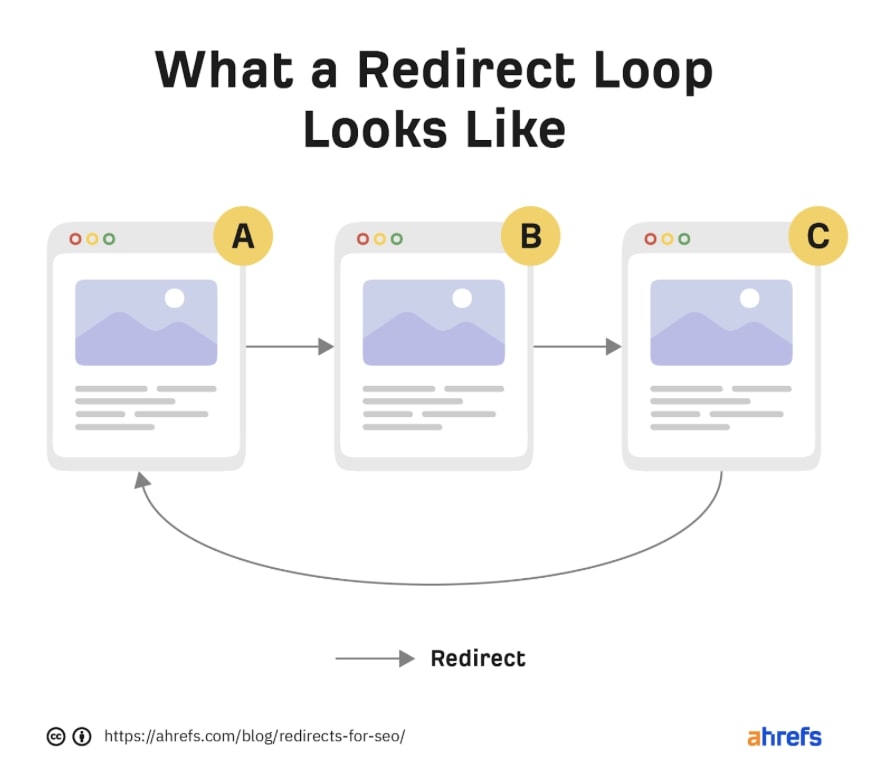
Reducing redirects results in faster loading times as by eliminating unnecessary redirects, the number of HTTP requests decreases, thereby speeding up the load time of your pages. This improvement can be especially beneficial for first-time visitors who do not have any cached resources.
When reducing redirects, you should also consider redirect chains. These occur when one URL redirects to another, which in turn redirects to another, and so on. When URLs reroute back to themselves, an endless redirect loop is created. Both issues can be identified using auditing tools and should be fixed by ensuring direct redirection to the final destination.
6. Use a Better Host
The hosting of your website lays its foundations, especially in relation to page speed. It determines how quickly data is transferred from the server to the visitor. A slow or overcrowded server can lead to the frustrating delays you would like to avoid. Specifically, a hosting plan’s bandwidth determines the data transfer rate between your website and its visitors. A higher bandwidth means faster page load times whereas limited bandwidth can lead to slow loading and incomplete page displays.
Moreover, scalability plays a vital role in website performance. This refers to the ability of a hosting environment to handle increased traffic loads without compromising performance. Essentially, it’s about how well your hosting solution can expand to meet the demands of your website as it continues to develop in terms of data, users, and content.
Therefore, it is in your business’s best interest to choose a hosting provider with a higher bandwidth and one that allows for scalability.
How Lumen SEO Can Help
We at Lumen SEO can take care of your whole SEO strategy, including keyword research, link building, content writing and technical SEO.
If you like the sound of working with us, we offer free, no-obligation SEO audits on business websites. This is a brilliant way to benefit from our expertise on topics such as website speed and general technical SEO.
To claim yours, simply enter your details here and we’ll get a free SEO audit to you within 7 days. It will include the strengths and weaknesses of your website along with the top three aspects you should focus on improving, in order to enhance your business’ ranking.
For a friendly chat about the SEO services we provide here at Lumen SEO, contact our SEO consultants today. Alternatively, you can message us on either our LinkedIn or Instagram pages.
Written by Viktoria, for Lumen SEO.


