
Published on 27/10/2025 & Updated on 23/01/26
Before AI was a thing, you’d pop your question into Google, have a look through the results, and click on a website (usually on page 1) to find your answer.
These days, you can often get what you need straight from Google’s AI Overviews, or skip search engines altogether and just ask ChatGPT or Google Gemini.
The way people search for information has changed and social media platforms have become search engines in their own right.
According to a recent report by Ofcom in the UK, ChatGPT has surged in popularity as an information discovery tool, with 252 million UK visits in August 2025 and over half of UK users reporting they frequently encounter AI-generated summaries in their search results.
This is why online brands face a serious choice – they either adapt to the new reality of AI-powered search, or run the risk of becoming invisible to an increasingly AI-dependent audience.
In this guide, you will learn all about AEO and how to optimise your website for AI.
What is Answer Engine Optimisation Marketing?
Answer Engine Optimisation is all about optimising your content so AI systems like ChatGPT, Bing AI, Perplexity or AI overviews show your content in their search results.

AEO vs SEO: What’s the Difference?
To put it simply, SEO (search engine optimisation) is all about getting your page seen on traditional search engines like Google. AEO, on the other hand, is about getting your answer/ site shown in AI search engines.
Search is shifting from “find the best page” to “get the best answer”, so rather than just ranking higher on a results page, AEO is all about optimising your content so that AI systems pull your response directly.
How to Optimise Your Website for AI Search
So you’re probably wondering… how do I actually make my website show up in AI? The good news is, you don’t need to reinvent the wheel, it’s just about building on what you already do for SEO and tweaking it so AI systems can easily understand, trust and use your content.
Below are a number of tried and tested key steps you can do to make your website AI-friendly. But if you fancy a bit of tailored help along the way, request your free AEO audit here.
1. Ensure Your Pages Provide Real Value
Ensure that your product and service pages clearly answer the questions people (and AI) are asking. This is because, if you don’t include key details, AI tools won’t know you’re relevant. It’s as simple as that.
Here are some things you can do to make your pages more helpful:
– Show off relevant case studies
– Include product or service details (ingredients, process, delivery)
– Add page-specific FAQs
– Feature verified reviews
– Back up claims with stats or data
– Use specific service pages, not just one generic “Services” page
2. Write Helpful Blogs
You can find thousands of blogs and articles on the internet. But what separates blogs that get quoted by AI tools (and actually bring in leads) from the rest? Real, human, helpful insight. AI tools like ChatGPT and Google’s Gemini value a real human touch – something that can’t be faked. So, make sure the text in your blogs sounds like you.
When writing useful content, make sure you’re: doing keyword research before so that you’re answering common questions, writing at least 700 words, internally linking to relevant pages, and adding an FAQ section.
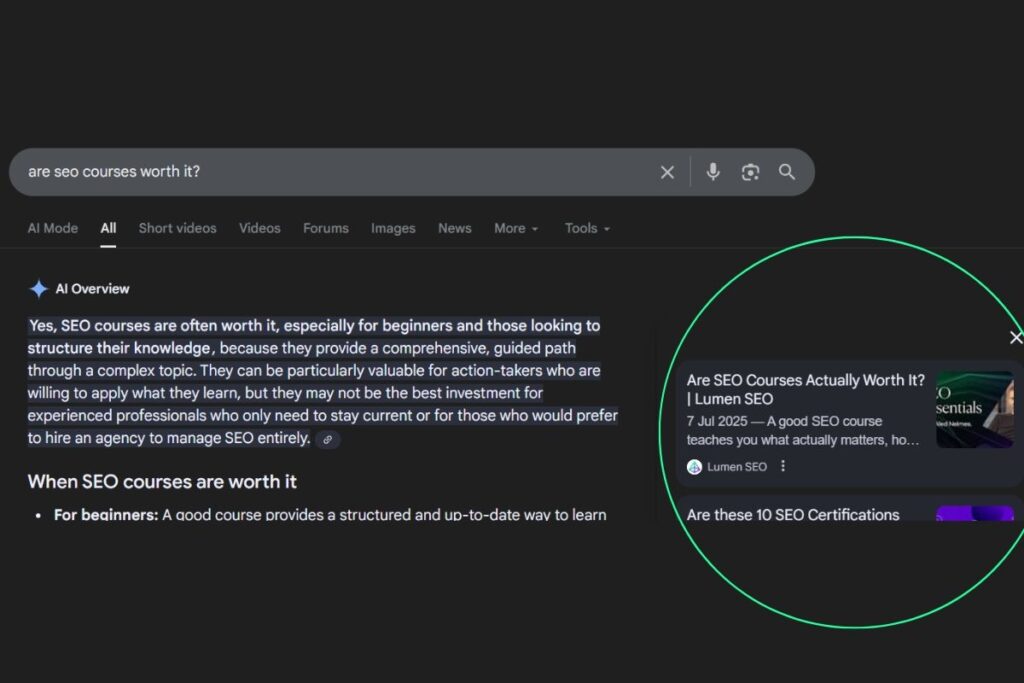
A top example is our recent blog titled ‘Are SEO Courses Worth It?’, which is now appearing in Google’s AI Overview. This blog is well structured, well-sourced, and confidently wrapped up with a clear CTA to sign up to our seo essentials online course.
3. Build Trust Across the Web
Much like ChatGPT, Google looks at your entire digital footprint to gauge how trustworthy and effective your content is as a solution, rather than focusing solely on on-page structure.
With this in mind, we recommend you working on the following areas outside of your website:
– Review platforms like Trustpilot or Google My Business, or specific platforms that are tailored to your industry.
– Digital PR – it changed everything for us when we started getting featured in The Financial Times for our 32-hour week, and our website traffic has been higher ever since.
– Forums like Reddit – try and spark conversions and get amongst the chat.
– Social media – if you have a social media profile that you’re not committed to, kill it off, and focus on growing your exposure on the channels you can commit to.
4. Ensure Your Pages Are Well Structured
Pages that perform best in AI results are often the ones that are well-organised and easy to read.
We recommend that you:
– Ensure you only have one H1 per page
– Use H2s, H3s, and bullet points to break up content
– Keep it easily scannable (ChatGPT loves a neat and tidy structure)
A great example is our client, Thames Rockets – their site is full of detail yet easy to digest. Articles, FAQs, location info – all neatly ordered. No surprise they’ve seen a 260% jump in clicks from ChatGPT!

If you fancy an SEO audit of your website, which specifically looks at improving your rankings on AI, we can help!
Insert a few details here for your AEO audit, and we’ll have it over to you within 48 hours. We look forward to it!